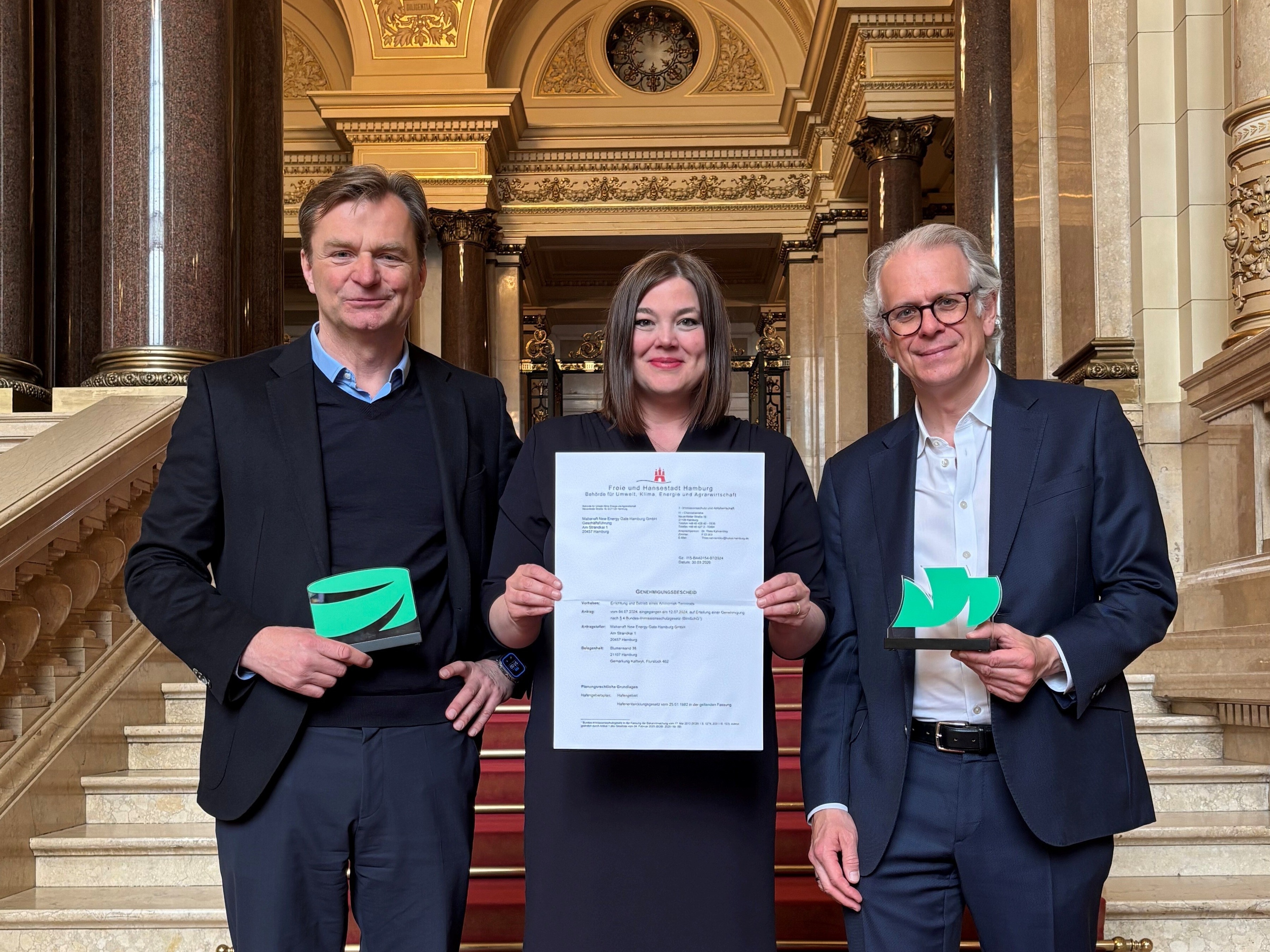
The planned terminal is intended for the import and redistribution of ammonia, which is not only a storage medium for hydrogen, but can also be used both as an industrial raw material and as an alternative fuel in shipping. Importing these molecules will support the domestic ammonia market and lay the groundwork for scaling up the hydrogen economy. In the long term, this is expected to further support the energy transition in shipping. From a technological point of view, it is also possible to use ammonia in gas-fired power stations. The terminal is designed to handle lower‑carbon and renewable ammonia as well, subject to technical capabilities, market availability, and applicable regulatory requirements.
The terminal is to be built on the site of the Blumensand tank terminal, the largest tank terminal in the Port of Hamburg, owned by the MB Energy group’s storage unit: enport by MB Energy. It forms a central part of the New Energy Gate Project, which also involves handling methanol at the same site. According to the plans, a new tank for the temporary storage of imported ammonia is to be constructed, and the existing berth for inland barges and seagoing vessels is to be upgraded to facilitate the import of this energy source. Plans are also in place for loading facilities for railcars. Furthermore, there are potential plans for a feed-in facility to a cracker plant, which is yet to be developed separately, where the ammonia can be split into hydrogen and could connect into the future hydrogen grid network. The planned throughput is expected to be estimated 600,000 metric tonnes of ammonia per year.
“Following a highly constructive permitting process on both sides, we are pleased to have the official document in our hands, marking a key milestone in taking the project forward,” says Volker Ebeling, Senior Vice President New Energy, Supply & Infrastructure at MB Energy. The planned ammonia terminal will significantly advance the energy transition in Hamburg. “It sends a strong signal towards a future-oriented and reliable supply of energy and raw materials,” he emphasises, adding: “On behalf of MB Energy, I would like to thank everyone involved for their excellent and solution-oriented cooperation throughout this complex process.”
About MB Energy
MB Energy, founded in 1947 and headquartered in Hamburg, is an independent, integrated energy company with operations across Europe, the United States, and Singapore. The company engages in the import, storage, distribution, and marketing of petroleum products, LPG, chemicals, and biofuels. With decades of industry experience and forward-looking approach, MB Energy plays an active role in the global energy landscape and supports the transition to lower emissions fuels through the development and provision of future-oriented alternatives.
About enport by MB Energy
Since 1972, enport by MB Energy has been a key player in tank storage logistics and ranks among the largest independent providers of tank terminal storage and infrastructure in Germany. enport owns and operates 13 terminals across Germany, Denmark and Hungary, offering a total storage capacity of 2.6 million cubic metres (cbm). With a strong regional presence and decades of operational expertise, enport contributes to the secure and efficient handling of energy products and chemicals in Europe.