Mabanaft is a proud partner of Lechner Racing, and as the 2023 Porsche Supercup season finale took place two months ago, it is time to look back on our joint successes this season. In the first season of the partnership,CO₂ emissions were reduced by 18.2 tCO₂e[1] through the use of renewable diesel (HVO100), whilst the remaining emissions were offset by voluntary emission reduction certificates (VERs). The aim for next season is to further increase the emissions reduction achieved through the use of renewable diesel (HVO100).
With the aim of enabling Lechner Racing to reduce the CO₂ emissions of its transport vehicles to net zero, Mabanaft and Lechner Racing entered into a long-term partnership in May, covering the Porsche Supercup seasons from 2023 to 2025. Under the agreement, Mabanaft will supply Lechner Racing with renewable diesel (HVO100) to refuel the lorries, and VERs to offset the remainingCO₂ emissions from road transport.
More than 20,000 kilometres across Europe
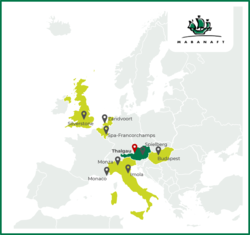
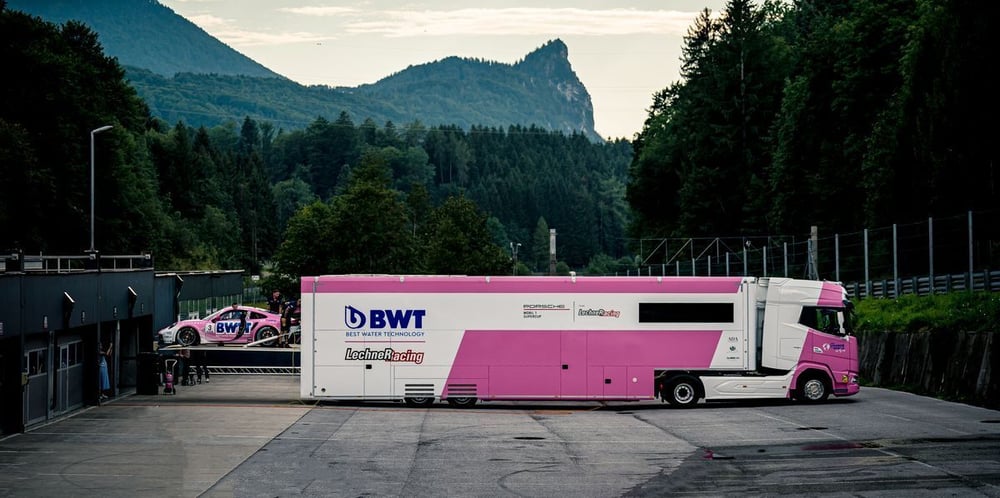
Lechner Racing’s logistics fleet comprises three transport vehicles: one large lorry and two smaller vans. The vehicles are used throughout the season to transport the team’s racing cars and other equipment from its headquarters in Thalgau, Austria, to eight race circuits across Europe and back again. During the 2023 season, from May to September, the vehicles covered a total of 20,652 km. The large lorry ran on renewable diesel (HVO100) throughout the season, whilst one of the vans was partly powered by renewable diesel (HVO100). The second van was powered by conventional diesel throughout the season. Thanks to the use of renewable diesel (HVO100),CO₂ emissions from the three team vehicles were reduced by 18.2 t CO₂e[2]. The remaining emissions of 13.5 tCO₂ewere offset through the use of VERs. Had the three team vehicles been powered by conventional fossil diesel, they would have emitted a total of 31.7 tCO₂e.
Fuel from renewable biomass sources
The renewable diesel (HVO100) supplied by Mabanaft to Lechner Racing was fully compliant with the EN 15940 fuel standard and also met the requirements for seasonal cold-flow properties. In terms of sustainability and greenhouse gas savings, the supplied renewable diesel (HVO100) was ISCC-certified and delivered greenhouse gas savings of over 90 per cent[3]. The product was produced from waste and residual materials in accordance with EU RED II Annex IX A and B.
Committed to using only high-quality certificates
To offset the remaining 13.5 tonnes ofCO₂ emissions from road transport, Mabanaft supplied VERs from a renewable energy project in Asia and redeemed them on behalf of Lechner Racing.
Mabanaft is committed to offering only high-quality certificates issued by recognised registries such as the Verra Registry. VERRA is a non-profit organisation that develops standards for environmental and social markets, including the world’s leading carbon credit programme, the Verified Carbon Standard (VCS) programme. By collaborating with recognised registries and exercising careful selection when procuring certificates, it can be ensured that the relevant projects efficiently reduce emissions and are verified and qualified to be labelled as such.
Successful both on and off the racetrack
In conclusion, the 2023 season was a great success. On the racetrack, Lechner Racing won both the team and drivers’ championships and was just one point away from winning the rookie championship as well, whilst off the racetrack, Mabanaft enablednet-zero CO₂ emissions from road transport vehicles. We are already looking forward to continuing this successful partnership in the 2024 season.
Watch the video below to find out more about how we help our customers decarbonise their logistics.
[1]All calculations are carried out in accordance with REDII calculation principles, based on data from Lechner Racing.
[2]All calculations are carried out in accordance with REDII calculation principles, based on data from Lechner Racing.
[3]Compared with the REDII benchmark value for fossil fuels of 94 gCO₂e/MJ.