
A Look Back at the Second Year with Lechner Racing
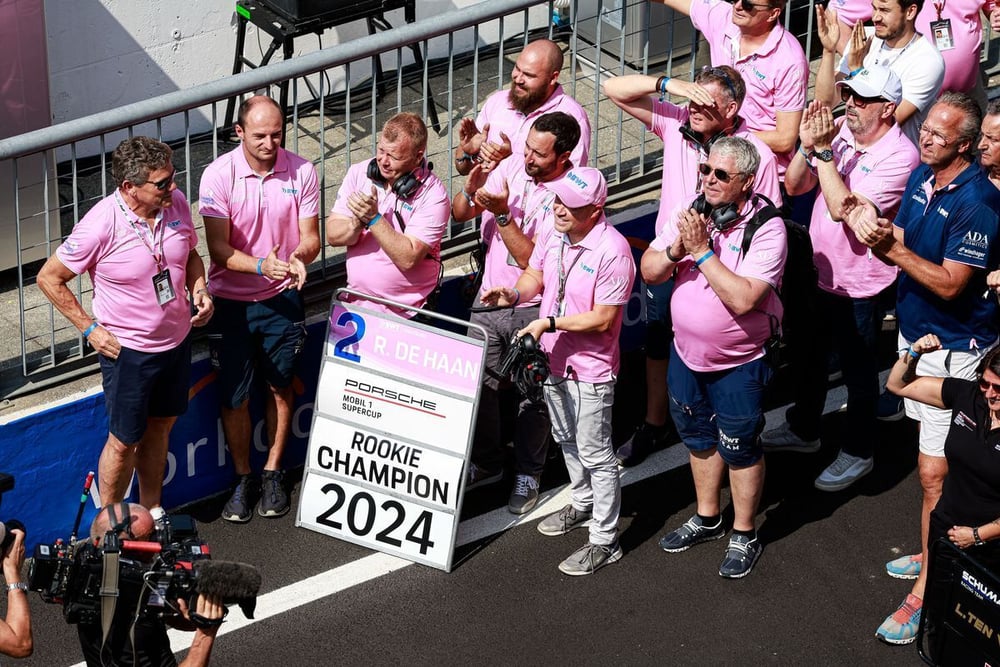
Mabanaft and Lechner Racing can look back on another successful year. The partnership – under which Mabanaft provides solutions to reduceCO₂ emissions from Lechner Racing’s transport logistics and operations – has been successfully expanded, and BWT Lechner Racing finished on the podium in all three championships.
As was the case last year, the BWT Lechner Racing team’s logistics consisted of three transport vehicles: one large lorry and two smaller vans. Over the course of the season, the vehicles were used to transport the team’s racing cars and equipment from its headquarters in Thalgau, Austria, to the eight race circuits across Europe and back again. In the 2024 season, the vehicles covered even more kilometres than in the previous year, as more test days were held during the racing series.
Expanded scope
Mabanaft supplies renewable diesel (HVO100) to Lechner Racing, thereby enabling the team to switch from conventional diesel fuel to renewable diesel (HVO100) for its transport vehicles. The greenhouse gas emission reduction factor for the Renewable Diesel (HVO100) supplied in 2024 was increased from 90 per cent in 2023 to 92 per cent[1]. Furthermore, the total volume of Renewable Diesel (HVO100) supplied to and used by Lechner Racing’s vehicles has increased from approximately 8,300 litres in 2023 to approximately 10,500 litres in 2024. Overall, in 2024,CO₂ emissions from Porsche Supercup operations were reduced by ~30 tCO₂e[2] through the use of renewable diesel (HVO100). The remaining ~15 t of emissions were offset by certificates.
In 2024, the partnership was also expanded to go beyond purely logistical aspects. The voluntary reporting of Lechner Racing’s Scope 1 and Scope 2 emissions[3] was incorporated into the scope of the partnership in order to gain a deeper understanding of the company’s direct emissions footprint, identify opportunities for improvement and strengthen efforts towards emissions offsetting. In this way, additional emissions amounting to ~72 t were documented and offset.
Further opportunities to expand the partnership
As we look ahead to the third year of the partnership, we are continuing to work together to identify ways to strengthen the relationship between the two teams.
Mabanaft will continue to support Lechner Racing in expanding its efforts in the areas of environmental, social and governance (ESG) – namely documenting and offsetting Scope 1 and 2 emissions, as well as strengthening collaboration on further ESG initiatives to further reduce Lechner Racing’s environmental impact.
In addition, measures to reduce emissions associated with the operation of the racing cars – such as emissions from racing fuel on test and race days – are being evaluated, whilst the potential for more comprehensive ESG reporting initiatives is also being explored.
We look forward to continuing this successful partnership in 2025
The 2024 season was very successful. On the track, Lechner Racing won the Rookie Championship and finished second in both the team and drivers’ standings. Off the track, Mabanaft enabled a further reduction inCO₂ emissions from transport vehicles. We are already looking forward to continuing this successful partnership in the 2025 season.
In the video below, you can see the Lechner Racing truck being refuelled with renewable diesel (HVO100) at our tankpool24 filling station in Kassel on its way to Zandvoort in the Netherlands.
[1] Compared to the REDII reference value for fossil fuels of 94 gCO₂e/MJ
[2] All calculations are carried out in accordance with REDII calculation principles, based on data from Lechner Racing
[3] Scope 1: Emissions from sources owned by the company. Scope 2: Market-based emissions from purchased energy