
Historic SAF delivery arrives in Copenhagen – growing demand in Danish aviation
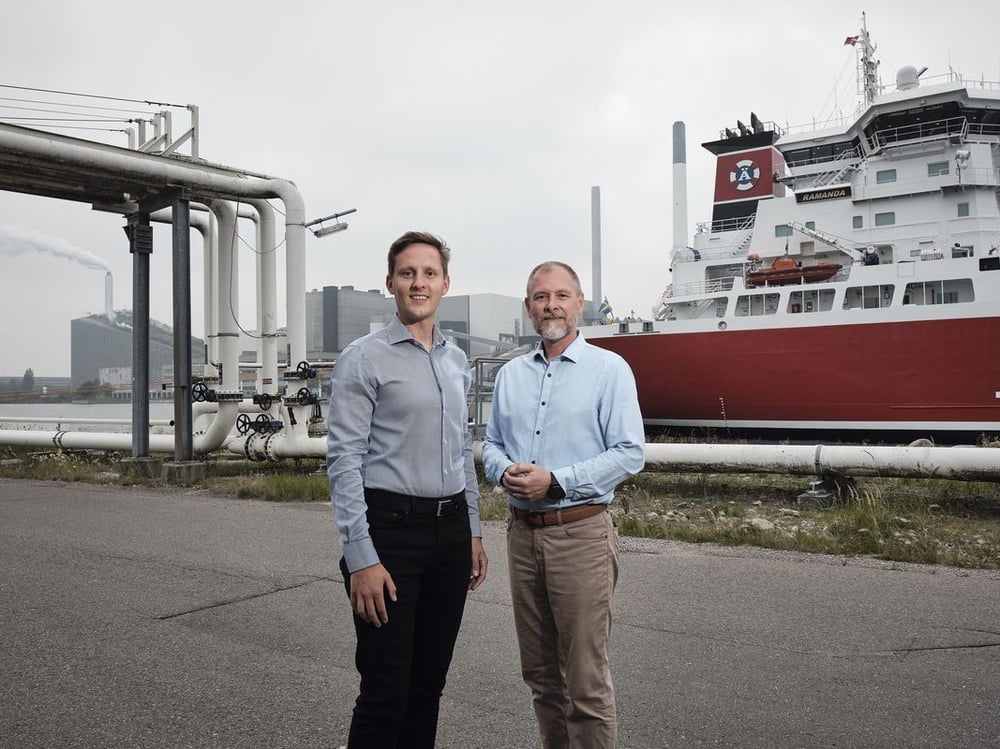
To meet the growing demand from airlines for sustainable aviation fuel (SAF), DCC & Shell Aviation Denmark have now established a large stock of bio-based aviation fuel (SAF) in Denmark for the first time. On 10 September, a tanker delivered a record quantity of SAF to a storage tank at Oiltanking Copenhagen’s terminal at Prøvestenen, which will now serve as a hub for reliable supplies to players in the Danish market.
With the first large-scale SAF storage facility on Danish soil, DCC & Shell Aviation are taking a further step towards meeting the growing demand for non-fossil aviation fuel*.
The Danish aviation industry has been taking the lead on its own initiative well ahead of 2025, when new EU regulations will require airlines to fly using an increasing proportion of SAF. This has led to a surge in interest and demand for SAF, which is now paving the way for the establishment of a large, land-based SAF storage facility in Denmark.
“We have been planning to establish a large-scale Danish supply base for SAF for several years. Since we began our first collaboration with Sønderborg Airport in 2021 for SAF deliveries on the domestic route to Copenhagen, things have developed rapidly. Since then, Billund Airport has joined the scheme, and most recently Copenhagen Airport through the SAF agreement we have concluded with Air Greenland,” explains Sune Petersen, Head of Sustainability & Strategy at DCC & Shell Aviation Denmark.
Together with Oiltanking Copenhagen, the owner of the terminal at Prøvestenen, a further step is now being taken to strengthen the infrastructure and the supply of SAF to the Danish market.
“From the Oiltanking Copenhagen tanks at Prøvestenen, we can not only feed SAF directly into the pipelines to Copenhagen Airport. We can also efficiently supply the other airports via our existing supply network. This facilitates the availability of SAF for all stakeholders and is a step towards the aviation sector’s transition to more sustainable forms of energy,” says Sune Petersen.
Prøvestenen is a key part of the region’s critical energy supply infrastructure
Oiltanking Copenhagen’s terminal at Prøvestenen is connected by pipeline to the country’s largest airport. According to Karl Henrik Dahl, Managing Director of Oiltanking Copenhagen, the terminal and port facilities at Prøvestenen, which are operated by Copenhagen Malmö Port, are of crucial importance for air traffic to and from Copenhagen. Furthermore, thanks to its large capacity and connection to the wider energy infrastructure, Prøvestenen plays a key role in the transition away from fossil fuels, which is already well under way.
“The establishment of a SAF storage facility directly linked to Copenhagen Airport is a good example of how Denmark already has a well-functioning infrastructure that also meets the aviation industry’s need for new types of fuel. In a few years’ time, Denmark will need to be able to handle large volumes of various types of liquid fuels, such as PtX-based fuels. In this respect, our infrastructure at Prøvestenen provides a solid and scalable foundation for ensuring a stable energy supply across the country, including as part of the energy transition. By utilising our capabilities here at Oiltanking Copenhagen, we can tackle the challenges of the energy transition together with our customers. And we will continue to work towards this in the future so that we can offer even more sustainable energy solutions as part of the energy transition,” he explains.
According to Sune Petersen, the latest investments in improved access to SAF in Denmark demonstrate how, step by step, more sustainable aviation fuels can best achieve the widespread adoption sought by industry and policymakers.
“To support more sustainable aviation efficiently and cost-effectively, we must be able to handle SAF deliveries on a very large scale. This is best achieved by utilising existing infrastructure. We must therefore move away from the idea of refuelling every single aircraft on a specific route with ‘green’ fuel. It is a matter of a mass balance, where airlines’ purchase of SAF forms part of the overall fuel supply and gradually replaces fossil-based aviation fuel. This applies regardless of whether the SAF is produced from bio-waste or is PtX-based, which can be produced in much larger quantities and even more sustainably using renewable electricity from wind turbines or solar energy and biogenicCO₂,” explains Sune Petersen.
*The SAF currently available for aviation is produced entirely from bio-waste. For example, from used cooking oil and waste from the food industry. Overall, the fuel can therefore reduce greenhouse gas emissions by up to 80 per cent compared with fossil jet fuel.
DCC & Shell Aviation Denmark is a joint venture between DCC Holding Denmark and Shell’s global Aviation Fuel Business. The company is responsible for all logistics and the supply of Shell aviation fuel to nine Danish airports, and is the largest independent supplier and consultant for aviation fuel in Denmark.
Oiltanking Copenhagen A/S is part of the Mabanaft Group, a leading independent and integrated energy company, and has a total storage capacity of 462 thousand cubic metres. Oiltanking Copenhagen A/S is located at Prøvestenen. The company leases storage capacity and provides related services to its customers. Its main product is aviation fuel, which is primarily supplied via a pipeline to Copenhagen Airport (Kastrup).
Mabanaft GmbH & Co. KG is a leading independent and integrated energy company that offers its customers innovative energy solutions in the transport, heating, industrial and agricultural sectors. The company is active in the import, distribution and marketing of petroleum products, natural gas liquids, chemicals and biofuels, and supports its customers in the transition to cleaner fuels by offering alternative long-term solutions.